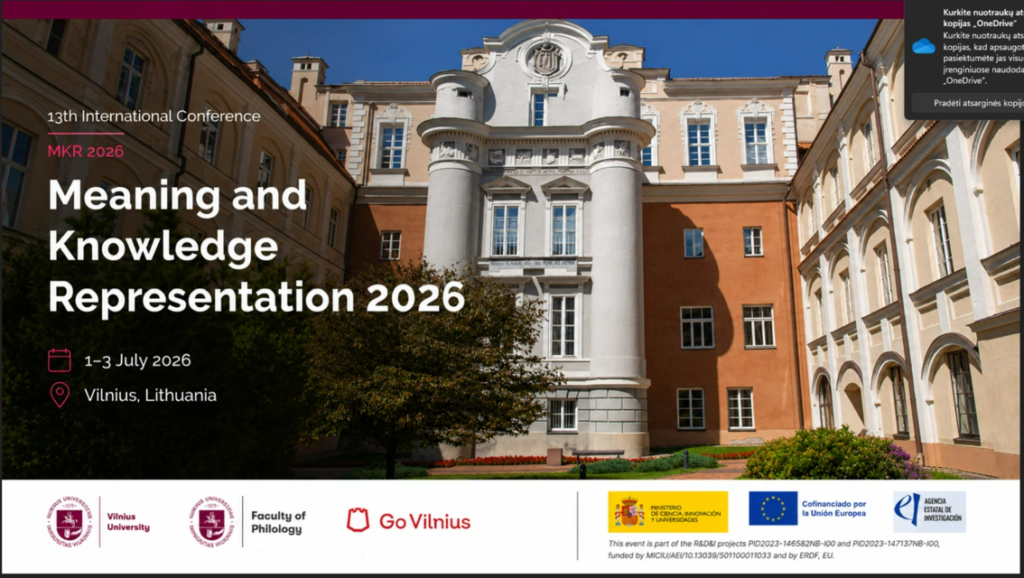
Between July 1–3, 2026, the 13th International Conference on Meaning and Knowledge Representation (MKR 2026) at Vilnius University (Lithuania) welcomed cutting-edge perspectives on technology and humanities. Within the framework of our ERASMUS+ KA220 project, Natalia Martínez-León and Ángela Alameda-Hernández (University of Granada, Spain) delivered a compelling presentation titled “Ethics and AI in Language Education: Challenges and Opportunities.”
The presentation argued that integrating Generative Artificial Intelligence (GenAI) into language education requires an urgent shift: moving away from a narrow, punitive focus on student cheating toward a comprehensive critique of broader socio-technical harms. Introducing a multi-level framework, the speakers analyzed ethical AI integration across seven interconnected dimensions—ranging from data colonialism, linguistic inequality, and the political economy of “ghost work” to algorithmic opacity, environmental degradation, and responsive classroom pedagogy. Structured across macro, meso, and micro levels, this visionary framework advocates for an institutional adoption of AI that is transparent, equitable, and deeply attentive to the linguistic, labor, and ecological realities of modern technology.